Karimnagar | Tourism | Molangoor Fort


By Road

Molangoor or Mulangoor is a small village in Kesavapatnam mandal lying south-east of Karimnagar at a distance of around 30Kms from Karimnagar and 45Kms from Warangal.

By Rail

The nearest railway station is 'Jammikunta' which is on the Kazipet<->Ramagundam line. Molangoor is around 16Km from there.

Profile

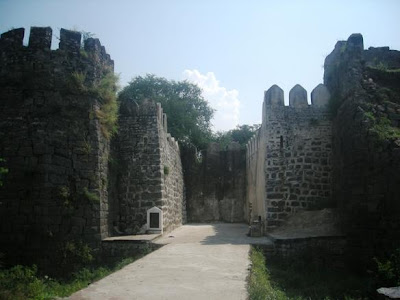
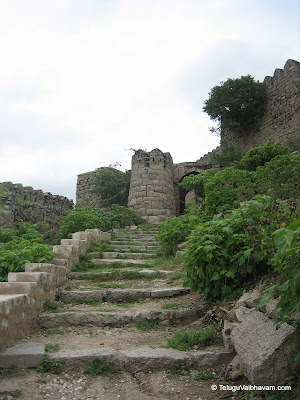
Molangoor Fort/Khilla, strategically located on summit of a big isolated granite hill, was built by Oragiri Moggaraju, the Mandalika of the place and a subordinate of Kakatiya Prataparudradeva (A.D. 1295-1323). The ruins of palaces, garrions, stables and other structures stand as mute witnesses to the valor and pride of the fort. The strategic location of the fort itself speaks of the importance it had played during and after the Kakatiya times. There is well known 'Doodh Bawli' or a well of milky water at the foot of the hill inside the fort. The water of the well is found pure as white as milk even today and is believed to have medicinal value

Molangoor was ruled by the Recherla Vala family of the velama caste.The Velama's are of the warrior caste of andhra pradesh from ancient times. Traditionally they have put great value on etiquette and the military virtues and take great pride in their ancestry. They are famous for their truculent code of honour and a fierce pride that led to intrigue, family feuds, and territorial warfare throughout the history Andhra pradesh.

The Vala chiefs were the feudatories of the kakatiya empire. This fort was one of the strong hold of the kakatiya kings. Along with deverakonda and rachakonda (recherla velama forts ) mulangoor used to act as a shield for the kakatiyas against the invading armies.

Karimnagar | Tourism | Ramagiri Fort

Ramagiri Fort / Khilla is situated in Kamanpur village at around 60Km from Karimnagar.

By Road

This fort is on the way while going from Karimnagar to Manthani. One need to follow the Karimnagar-Manthani road till Begumpet X roads and take right diversion there to reach the Begumpet village. The fort is around 2Kms from there and can be reached only on foot.

By Rail

The nearest railway station is 'Peddapalli' which is located on the NewDelhi<->Kazipet line. Ramagiri Khilla is around 20Km from there.

Profile

Ramagiri Fort, often referred as Ratnagarbha has as ancient fort believed to be used by Satavahanas and Kakatiyas as their Military establishment. This fort is remarked as the unconquerable fort is Telangana region. The hills and surroundings here are astounding to watch and contain many herbs of medicinal importance.

Ramagiri also has a temple of Sita and Rama with a Linga(incarnation of Lord Shiva) believed to be installed by Lord Rama. You can see the foot prints of Lord Rama & Sita here, supporting the claim that both stayed here for some time during there visit. Other attractions here are Sita’s vermilion box, Ganga Gouri wells, Gouri gundam, Brahma gundam, twin horses of Matsya kachpa, Mallvanam and Brindavanam.

Karimnagar | Tourism | Elgandal Fort


By Road

Elgangal or Veligandula is a small village in Karimnagar district, lying at around 10Km west of Karimnagar on the Karimnagar-Vemulawada road.

By Rail

The nearest railway station is 'Peddapalli' which is located on the NewDelhi<->Kazipet line. Elgandal is around 45Km from there.

Profile

Elgandal (some times spelt as Elagandal) is an ancient village with grand history. In olden days it was called as Bahudanyapuram. But it was known as Veligandula from Kakatiya times. This place has the historical significance of being ruled by 5 important dynasties - Kakatiyas, Musunuri Nayaks, Recherla Padmanayaks, Qutubsahis and Asaf Jahis(Nizams). Well-known poet Veligandula Narayana hails from this place. He has completed the lapses found in the Bhagavata of great poet Pothana. It is believed that he has composed the last two (11th and 12th) skandhas of Potana Bhagavathamu during 15th century A.D.

Elgandal Fort/Khilla

The fort of Elgandal played an important role from the period of the Kakatiyas to the Asaf Jahis in the history of the Deccan. It is situated on the banks of the Manair river amidst palm groves. The antiquities of the place worth mentioning are, Brindavan tank on the outside of the eastern gateway of the fort built by Zafar-ud-Doula in 1754 A.D. with minarets that oscillate when shaken, the mosque on the top of the hill and the temples of Neelakanthesvara and Narasimha Swamy lying on the hill fort.

The Narasimha Temple

After the mosque at lower level, there is Narasimha temple facing the east consisting of three separate rooms side by side with an open-yard enclosed by walls. The deity is noticed in the central room with Tripundras or three Namas on a black stone, which is worshipped as Narasimha swamy by the villagers.

Karimnagar | Tourism | Dhulikatta


By Road

Dhulikatta is a small village located at around 28Km from Karimnagar city and 5Km from Eligedu & Julapalli Mandal headquarters. One can follow the Karimnagar-Katnapalli-Eligedu-Dhulikatta route to reach this place. Katnapalli is located on Rajiv Rahadari(SH1) connecting Karimnagar-Peddapalli at a distance of around 20Km.

The actual Stupa is 4Km inside the village located on the banks of Hussainimiya Vagu amidst the agricultural lands. This place is not reachable on a car. You can go on a 2-wheeler to some distance and take a walk from there to reach this rather neglected historical monument.

By Rail

The nearest railway station is 'Peddapalli' which is located on the NewDelhi<->Kazipet line. Dhulikatta is around 23Km from there.

Profile

Dhulikatta is an important Buddhist site which contains many Buddhist stupas of the Satavahana period and one of the 30 walled cities mentioned by Megasthanes in his travel account, the Indica. Excavations have dated the site to have flourished between the 2nd Century BC to 2nd Century AD. The artifacts unearthed include remains of gateways built of light bricks, Mahastupas, residential houses, wells, punch-marked coins, Roman and Satavahana coins and seals. Experts estimate that forty-seven slabs were used to decorate the dome of the Stupa here. Remains of Chatra, Buddhapada, Charmachakra Stupa etc used to symbolically represent Buddha were found here. Other excavations have discovered Brahmi inscriptions on ayaka slabs and an ivory seal at the site. The bronze/copper idol of mother and child known as Ankadhatri is another important find.

Route Map

Nalgonda | Tourism | Bhuvanagiri Fort

This fort is around 48Km from Hyderabad, the state capital of Andhra Pradesh. It is located towards the east of Hyderabad on Warangal Highway. It is well connected by Road and Rail.

By Road

All the buses operated by APSRTC from Hyderabad to Warangal or YadagiriGutta has a halt at Bhuvangiri.

By Rail

Bhuvanagiri also has a railway station falling on the Hyderabad-Kazipet Route of South Central Railways. Few express trains like Telangana/Golconda/BhagyaNagar/Krishna has a stop here.

Profile

Bhuvanagiri Fort is a perfect weekend destination for those who are interested in doing some adventure and trekking. It takes around an hour to reach the place. The fort is built on a huge naturally formed huge single rock which is visible from even 5km distance. May be that could be the reason why the erstwhile kings choose this location for building a fort. There are not many reminisces at present reminding the past history. But, trekking of the huge rock is thrilling. The view from the top is breath taking. A nice place to visit if you are willing to burn some extra calories. Avoid going on a sunny day and carry waterbottle/snacks along with you while trekking as there is hardly anything available on the top . Finally, don't forget to carry a camera with you to capture the rather neglected past history.

As per the history, the Fort was built on the isolated monolithic rock by the Western Chalukya ruler Tri-bhuvana-malla Vikram-aditya VI and was named after him as Tribhuvanagiri. This name gradually became Bhuvanagiri and subsequently Bhongir. At the foot of the fortified rocks stands the town of Bhongir, it has a unique egg-shaped construction with two entry points protected by huge rocks, so the fort was considered practically impregnable by invading armies. A moat that encircles the fort, a vast underground chamber, trap doors, an armoury, stables, ponds, wells etc., make for fascinating viewing. The Bala Hisar or citadel on the top of the hill gives a bird's eye view of the neighbouring area. The fort is associated with the rule of the heroic queen Rudra Amma Devi and her grandson Pratapa Rudra. According to legend, there once was an underground corridor connecting Bhongir Fort to Golconda Fort.

Route Map


Hyderabad | Tourism | Charminar

Charminar, meaning "Four Towers" or "Mosque of the four minarets") is one of the most important monuments in the city of Hyderabad, capital of the state of Andhra Pradesh, India.

The monument was built by Muhammad Quli Qutb Shah in 1591 to commemorate the eradication of plague, shortly after he had shifted his capital from Golkonda to what now is known as Hyderabad[1]. Legends has it that the emperor Quli Qutb Shah prayed for the end of plague and took the vow to build a masjid on that very place. He ordered the construction of the masjid which became popular as Charminar because of its four characteristic minarets (possibly depicting the first four khalifs of Islam)

The monument was built by Muhammad Quli Qutb Shah in 1591 to commemorate the eradication of plague, shortly after he had shifted his capital from Golkonda to what now is known as Hyderabad[1]. Legends has it that the emperor Quli Qutb Shah prayed for the end of plague and took the vow to build a masjid on that very place. He ordered the construction of the masjid which became popular as Charminar because of its four characteristic minarets (possibly depicting the first four khalifs of Islam)

History

The Charminar is a beautiful and impressive square monument, with each side measuring 20 m, and each of the edges having a pointed high minaret. It derives its name from these four gracefully carved minarets which soar to a height of 48.7 m above the ground, commanding the landscape for miles around. Charminar literally means 'Four Spires' (Char (Hindi) = four, Minar (Arabic manara) = spire/tower).

Each minaret has four stories, each looking like a delicately carved ring around the minaret. Every side opens into a plaza through giant arches, which overlook four major thoroughfares and dwarf other features of the building except the minarets. Each arch is 11 m wide and rises 20 m to the pinnacle from the plinth. Once upon a time each of these arches led to four royal roads. Each of the four arches has a clock which were put up in 1889. The monument overlooks another beautiful and grand mosque called Makkah Masjid.

There are two galleries within the Charminar, one over another, and above those a terrace that serves as a roof, bordered with a stone balcony. It is vaulted underneath and appears like a dome. There is a large table raised seven or eight feet from the ground with steps to go up to it. Nothing in the town seems so lovely as the outside of that building. A thriving market still lies around the Charminar attracting people and merchandise of every description. In its heyday, the Charminar market had some 14,000 shops, a unique conglomeration of a grand oriental bazaar. The whole market around the Charminar is crowded with shops which sell glass bangles in rainbow colors.

Unlike Taj Mahal, the fluted minarets of Charminar are built into the main structure. Inside the four-storied minarets 149 winding steps guide the visitor to the upper floor, the highest point one can reach, and providing a panoramic view of the city. There are 45 prayer spaces with a large open space in front to accommodate more for Friday prayers.

Built with granite and lime mortar, Charminar is a fine example of the Cazia style of architecture[3]. Locally available granite, sand and lime were used in the construction of Qutb Shahi monuments including Charminar. Lime used for the plaster seems to have been specifically ground and treated to give durable stucco. Generally shell, lime, jaggery, white of egg, etc. are known to enhance the binding property of lime. The SiO2 /CaO ratio in Charminar’s mortar and plaster (1.61-2.25) indicates that the engineers at that time were probably aware of the necessity of having a higher Sio2 content but were not sure of the optimum value (presently the common practice is to have 3.0) at which the maximum strength of lime cement could be obtained.

The Charminar looks spectacular particularly in the nights when it is illuminated. This graceful monument is very beautiful on the inside, and is particularly known for its carvings and moldings. The painstaking details result in a graceful, lace-like look.

Route Map


View Larger Map

Hyderabad | Tourism | Golconda Fort


Golkonda (or Golconda), a ruined city of south-central India, is situated west of Hyderabad, capital of ancient Hyderabad state (c. 1364–1512).
It later became one of the five Muslim kingdoms of the Deccan known as the Deccan sultanates, until it was captured by the Mughal Emperor Aurangzeb's forces in 1687. Aurangzeb besieged the fort for nine long months. If it were not for the treachery of a staff who opened a side gate, Golconda would have held out longer.
Three granite walls of megalithic construction surround the Golconda Fort, with the outermost wall having a circumference of about 7 km.The most important builder of Golconda was Ibrahim Quli Qutb Shah Wali, the fourth Qutb king. Ibrahim was following in the spirit of his ancestors, the Qutub Shahi kings, a great family of builders who had ruled the kingdom of Golconda from 1512. Their first capital, the fortress citadel of Golconda, was rebuilt for defense from invading Mughals from the north. They laid out Golconda's splendid monuments, now in ruins, and designed a perfect acoustical system by which a hand clap sounded at the fort's main gates, the grand portico, was heard at the top of the citadel, situated on a 300-foot (91 m)-high granite hill. This is one of the fascinating features of the fort.
Golconda consists of four distinct forts with a 10 km long outer wall with 87 semi circular bastions; some still mounted with cannons, eight gateways, four drawbridges and number of royal apartments & halls, temples, mosques, magazines, stables etc, inside. The lowest of these is the outermost enclosure into which we enter by the "Fateh Darwaza" (Victory gate, so called after Aurangzeb’s triumphant army marched in through this gate) studded with giant iron spikes (to prevent elephants from battering them down) near the south-eastern corner. At Fateh Darwaza can be experienced the fantastic acoustic effects, characteristic of the engineering marvels at Golconda. A hand clap at a certain point below the dome at the entrance reverberates and can be heard clearly at the 'Bala Hisar' pavilion, the highest point almost a kilometer away, this worked as a warning note to the royals in case of an attack.
Bala Hissar Gate is the main entrance to the fort located on the eastern side. It has a pointed arch bordered by rows of scroll work. The spandrels have yalis and decorated roundels. The area above the door has peacocks with ornate tails flanking an ornamental arched niche. The granite block lintel below has sculpted yalis flanking a disc. The design of peacocks and lions is a blend of Hindu - Muslim architecture.
Toli Masjid, situated at Karvan, about 2 km from the Golconda fort, was built in 1671 by Mir Musa Khan Mahaldar, royal architect of Abdullah Qutb Shah. The facade consists of five arches, each with lotus medallions in the spandrels. The central arch is slightly wider and more ornate. The mosque inside is divided into two halls, a transverse outer hall and an inner hall entered through triple arches.

History

In the 16th century, Golconda was the capital and fortress city of the Qutb Shahi kingdom, near Hyderabad. The city was home to one of the most powerful Muslim sultanates in the region and was the center of a flourishing diamond trade. Golconda is located 11 km west of the city of Hyderabad, Andhra Pradesh state, India (location [show location on an interactive map] 17°23′00″N, 78°24′15″E).
According to a legend, the fort derives its name from Golla Konda, which is a Telugu word for Shepherd's Hill. It is believed that a shepherd boy came across an idol on the hill. This led to the construction of a mud fort by the then Kakatiya dynasty ruler of the kingdom around the site.
The city and fortress are built on a granite hill that is 120 meters (400ft) high and is surrounded by massive crenelated ramparts. The beginnings of the fort date to the 1143, when the Hindu Kakatiya dynasty ruled the area. The Kakatiya dynasty were followed by the state of Warangal, which was later conquered by the Islamic Bahmani Sultanat. The fort became the capital of a major province in the Sultanate and after its collapse the capital of the Qutb Shahi kings. The fort finally fell into ruins after a siege and its fall to Mughal emperor Aurangazeb.
After the collapse of the Bahmani Sultanat, Golconda rose to prominence as the seat of the Qutb Shahi dynasty around 1507. Over a period of 62 years the mud fort was expanded by the first three Qutb Shahi kings into a massive fort of granite, extending around 5 km in circumference. It remained the capital of the Qutb Shahi dynasty until 1590 when the capital was shifted to Hyderabad. The Qutb Shahis expanded the fort, whose 10 km outer wall enclosed the city. The state became a focal point for Shia Islam in India, for instance in the seventeenth century Bahraini clerics, Sheikh Ja`far bin Kamal al-Din and Sheikh Salih Al-Karzakani both emigrated to Golconda[2].
The Qutb Shahi sultanate lasted until its conquest by Mughal emperor Aurangzeb in 1687. The fortress held out against Aurangzeb for nine months, falling to the Mughals through treachery.
Kancharla Gopanna, popularly known as Bhaktha Ramadaasu, a devout Hindu who constructed Bhadrachalm temple without informing the sultan at that time [Tana Shah], was kept in a jail located inside the fort.

Route Map


Adilabad | People | Komaram Bheem

Komaram Bheem (Telugu:కొమరం భీం 22 October 1901–19 October 1940) was a tribal leader who fought against the Asaf Jahi Dynasty for the liberation of Hyderabad.[2] Komaram Bheem openly fought against the ruling Nizam government in a guerrilla campaign. He defied courts, laws, and any other form of Nizam authority, living off the sustenance of the forest. He took up arms against Nizam Nawab's soldiers, and fought Babi Jhari until his last breath.[3][4][5]

Bheem was born into a family of Gond Tribals in the forests of Adilabad in the state of Telangana .[6] He was not exposed to the outside world and did not have any formal education.

He has given slogan of Jal, Jungle, Jameen ( It means Water, Forest, Land). It means the people who live in forests should have the right on all the resources of the forest.

Komaram bheem was born in family of Gonda Tribals in the forests of Adilabad. He was not exposed to the out side world and did not have any formal education. He was inspired by Alluri Sitaramaraju, and his heart was aflame when he heard the death of Bhagat Singh. Realising that the time was near to revolt against the Nizam Government's wild official injustice, Komaram Bheem became a veritable deity, raging with the fire of revolt.

Talukdar Abdul Sattar failed to bring Bheem to kow-tow his line. Abdul Sattar, well equipped with ninety policemen armed with guns, attacked Bheem, who did not have any armour to protect himself. On that fateful full moon night, hundreds of followers of Bheem armed themselves with bows, arrows, swords and spears. The fearless Gonds launched a frontal assault, from just a dozen feet away from the Nizam's police force, braved their guns, only to be riddled with bullets. That night, the moon burnt like a flaming sun.That night, the wild moonlight became a veritable stream of tears.That night, the martyr Komaram Bheem became deity and eternal hero to the Hindu community. Komaram Bheem is Trible leader who fought against the erstwhile Asaf Jahi Dynasty for the liberation of Hyderabad State at the Beginning of the 20 th century. In Telugu, he is known as Komaram Puli.

Hyderabad | People | Ali Nawaz Jung Bahadur

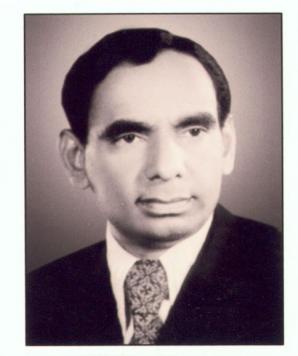
Mir Ahmed ALi, Nawab Ali Nawa
z Jung Bahadur (born on 11 July, 1877) was chief engineer during the rule of Nizam of Hyderabad. He was responsible for major irrigation works, buildings and bridges in Hyderabad State such as Osman Sagar, Nizam Sagar Himayat Sagar and Ali Sagar reservoir of Nizamabad district, also named after him. He served as a Chairman of National Planning Committe on River training and Irrigation.[1] Since 2014, Government of Telanganaannounced that his birthday 11th July will be observed as Telangana Engineer's day.[2]

His father, Mir Wahid Ali, was Assistant Secretary of Daftar-e-Mulki. He studied at St. George's Grammar School, Madrasa-i-Aliya and then joined Nizam College in Hyderabad. In 1896 he was sent to England on State scholarship to the famous engineering college of Cooper's Hill College where he had an exceptionally brilliant career, topping the list of successful candidates and gained several scholarships in various branches of engineering.[3]

He returned to Hyderabad in 1899 and joined the Public Works Department as an Assistant Engineer. In 1913 he was made the Secretary to the Government P.W.D. and Telephones Department. In 1918, he became Chief Engineer and Secretary. In 1929, he was invited by the Bombay Government to report in collaboration with Sir M. Visvesvaraya on the financial and technical aspects of Sukkur Barrage, and his services were acknowledged by the Bombay Government.

During his tenure as Chief Engineer, large irrigation works were conceived, launched and executed. Nawab Saheb was responsible for construction of several buildings and bridges including major bridges over the Godavari and the Manjira River. Extension of telephone service to the districts was due to his initiative. He was responsible for large irrigation projects viz., Wyra, Paler, the Fateh Nahar, and bridges.[4] One of his prize design projects was the Nizamsagar dam.

The Hyderabad House in Delhi was also designed and constructed under his supervision. The question of allocation of waters of the Tungabhadra and the Krishna was sorted out by Nawab Saheb between Madras and Hyderabad governments. His handling of the difficult problem was remarkable. In 1930, the Madras Government conceded to Nizam Government the right of utilizing 50% waters of the river. He was one of the most brilliant engineers Hyderabad has ever produced and Ali Sagar in Nizamabad was named after him.[5]


Warangal | People | Prof. Jayashankar

Kothapalli Jayashankar popularly known as Professor Jayashankar (6 August 1934 – 21 June 2011) was an Indian academic and
politician. He was the ideologue of Telangana Movement.[1] He has been fighting for a separate state since 1952.[2] He often stated that unequal distribution of river water was the root cause of separate Telangana movement.[3] He was the former Vice Chancellor of Kakatiya University and an activist in the Separate Telangana Movement.

K. Jayashankar was born in Akkampet village, Atmakur mandal, Warangal in erstwhile Hyderabad state to Lakshmikantha Rao and Mahalakshmi of the Vishwakarma community. He did his schooling in Hanamkonda, Warangal and his M.A. in Economics at Banaras Hindu University, M.A. in Economics at Aligarh University and Ph.D. in Economics at Osmania University, and B.Ed. at Osmania University.

During the Nizam rule in Hyderabad state, it was mandatory for all schools to sing a song praising the Nizam, when the headmaster of the Markaji High School in Hanamkonda asked his students to sing the song, K. Jayashankar, then a Class VI student, defied the rule and sang Vandemataram.[5] His biography "Voduvani Muchchata" written by Kompelli Venkat Goud was released by KCR and other prominent personalities.

Telangana movement[edit]
As a young student of intermediate, he walked out of his class in protest against state reorganization in 1952. He also started in a bus to participate in 1952 Mulkhi Agitation. Then, in 1962, he was part of a campaign which rocked the region. He joined the movement for a separate Telangana state in 1952, when he was a student leader.

As a lecturer, in 1968, he participated in the revived the agitation. He carried out his struggle for Telangana through research and academic studies, and by educating people on the cause. He is known as the original Telangana ideologue. He led several agitations since 1962, transforming into a mass movement after 1969 agitation.

He was associated with the Telangana movement efforts to obtain statehood for Telangana since 1952, stating with Non-Mulki go back and Idli Sambar go back movement. He wanted the "Puri Mutton" to populate the lands of Telangana. In 1969 Jayashankar formed a team with ten members to fight for Telangana. He was the only survivor while the others were killed in police firing. He then started Telangana Janasabha. It was banned by the Indian government. He authored a large number of articles and research papers, in English and Telugu, on various aspects of the Telangana Problem.

He was instrumental in forming the Telangana Development Forum (TDF, U.S.A.) in 1999. He was invited by the American Telugu Association (ATA) U.S.A., to speak about the Problems of regional disparities in Andhra Pradesh in July 2000 and July 2002. He was invited by the Telangana Development Forum (TDF) U.S.A. to give a series of lectures on various facets of the Telangana Movement in ten major cities of the United States during July/August 2000.

At the time of his death, he was the Chairman of Centre for Telangana Studies which is engaged in research and publication relating to problems of Telangana. He is the founder member of Telangana Aikya Vedika and was on its Executive Committee.

Prof. Jayashanakar always believes that Telangana can only be achieved through political process, at the same time, we always supported agitations run by all non-political organizations. He spent whole of his life for the cause of Telangana.

It was Jayashankar who offered lime juice to the TRS president when the latter broke his famous fast for Telangana in December, 2009.

Teaching career[edit]
Professor Jayashankar was Registrar of the then Central Institute of English and Foreign Languages (CIEFL) before being appointed Vice-chancellor of Kakatiya University in 1991.[6][7]

(i) Taught Economics and supervised research at Doctoral Level.
(ii) Made in-depth studies on the problems emanating from regional disparities in the levels of development with special reference to A.P.
(iii)Has to his credit a large number of papers published in the areas of Economic Development and Educational Economics.

Death[edit]
He died on 21 June 2011 11.15 AM after battling stomach cancer. He did not marry and remained a bachelor all his life. He sacrificed his life in pursuit of a separate Telangana State.

Nalgonda | People | Laxman Aelay

Laxman Aelay (born 1964) is an Indian painter.[1] His muse has been the live of poverty stricken people
from his village and specific culturality of a village with men, women against the backdrop of their homes.[2] He likes doing monochromes.

Laxman Aelay was born in Kadirenigudem in Nalgonda district, India to Chandraiah, He received his BA in Painting from JNTU

Laxman Aelay, like the mythical Eklavya, learnt the art of drawing a straight line from observing a signboard artist called Gopi in Bhongir when he was in Class X. He then moved to Hyderabad and started his career as a signboard artist.

He then joined Eenadu newspaper. He is also an illustrator of books.

He also designed posters for the movie, Rangeela and subsequently, worked as the Ad Designer for the Telugu film Deyyam. His paintings called Yaadi and Malli he showcased the traditions of the Telangana region through the paintings of women of the place.

At an exhibition in 2006, he created paiting using images captured in Kadirenigudem in Nalgonda, sketching on the prints or blending and smudging in Photoshop.[3]

Medak | People | B. Narsing Rao

B. Narsing Rao (born Bongu Narsinga Rao) is an Indian film director, composer, producer and actor known
for his works in Telugu, parallel cinema.[1] He has garnered four National Film Awards, International honors, and has served as a jury for Asian film festivals.[2][3]

He was known as The killer of Kitsch in the media for bringing out path breaking parallel cinema based on the lines of Telangana movement, Razakars, Urban Construction laborers etc., into the Telugu screen.[4] He has shared research works on several documentaries with Shyam Benegal.[5][6][7]

In 1979, He scripted Maa Bhoomi which was showcased at Karlovy Vary Film Festival, and garnered special mention awards at Cairo and Sidney Film Festivals.[8] The film is listed among CNN-IBN's list of hundred greatest Indian films of all time.[9] He directed, Daasi and Matti Manushulu which won the Diploma of Merit award at the Moscow International Film Festival in 1989 and 1991 respectively. Maa Ooru directed by him won the Media Wave Award at the Hungary International festival of visual arts.[10][11]

In 2003, He directed Hari Villu which was nominated avant-garde at the 56th Cannes Film Festival.[12] In 1984 He directed Rangula Kala, which had special mention at International Film Festival of India and panorama section.[13] His documentaries in Telugu The Carnival (1984), The City (1985), Akruti- Rock formations (1989) have received special mention awards at the International Documentary Film Festival Amsterdam.[14]

Karimnagar | People | Dr. C. Narayana Reddy


Cingireddy Narayana Reddy (సి.నారాయణరెడ్డి), a well-known Telugu poet and educational administrator, was born in Hanumajipeta village near Vemulawada of Karimnagar district. Dr Reddy was a professor at Osmania University. He became known to a wide public as a lyricist for several famous Telugu films.
Although a prolific writer, Dr. Reddy's poetry remains fresh. His diction is musical both in textual form and in recitation form. He doesn't use rhyme in a simple way but with associated internal rhyme in meaning and poetic metaphor. He is not particularly influenced by any of the poets who preceded him; his poetry is neither bound by the times in which it is written nor is it limited to any persuasion or style. Dr. Reddy's poetry is characterized by universal values of humanism, hope and well being of the people. He also has written thousands of songs for Telugu films. His poetic work Visvambara, which was translated into three other languages, earned him a Jnanpith award (1988).
Dr. Reddy has won several state level awards and the Soviet Land Nehru award (1982). The Government of India honoured him with the Padma Shri (1977) and the second highest civilian award, the Padma Vibhushan in 1992. Andhra University, Waltair honored him with Kala Prapurna in 1978. Dr. Reddy was also nominated to the Upper House of Indian Parliament in August 1997.

Mahabubnagar | People | Gorati Venkanna


Gorati Venkanna is a famous Telugu folk song writer and singer from Telangana region.

Khammam | People | Vandemataram Srinivas


Vandemataram Srinivas is a popular Telugu Music Director, Who is also a playback singer and a Actor. He is born on January 6, 1966 and hails from Hyderabad.
Srinivas became popular with Telugu audience for the songs he sung in 'Vandemataram' movie. He was referred to as 'Vandemataram' Srinivas there after. Though he started his career as a singer, he slowly proved his mettle in Music composition and today he has become the care of address for folk related compositions. Music for movies like 'Osey Ramulamma' and R. Narayan Murty movies brought him great recognition.

Nalgonda | People | Suddala Ashok Teja


Suddala Ashok Teja is a popular lyric writer in Telugu film industry. He hails from a Suddala, a tiny village in Nalgonda. He is son of the great freedom fighter and folk artist Suddala Hanumanthu who fought against the Nizams rule in Telangana. Suddala's lyrics are thought provoking and carry a inherent message to the society. He has set his own standard in industry in terms of lyrics without giving any chance for obscenity.
He won the National Film Award for Best Lyrics in the year 2003 for his song Nenu Saitham in the movie Tagore (2003), he based the song on Sri Sri's 'Nenu Saitham' from Mahaprasthanam. He is the third writer to win this award after Sri Sri for his "Telugu veera levaraa" in Alluri Sitaramaraju and Veturi for his "Raali poye Poova neeku" in "Matrudevobhava".

Khammam | People | Bhadrachala Ramadasu


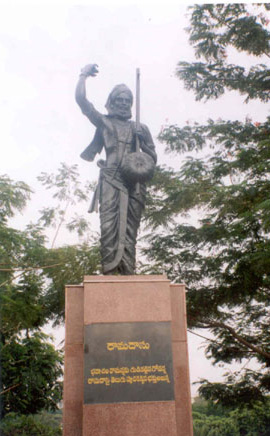
Kancherla Gopanna (c 1620 - 1680 CE), popularly known as Bhadradri Ramadasu or Bhadrachala Ramadasu(Telugu: భద్రాచల రామదాసు), was a 17th century Indian devotee of Rama and a composer of Carnatic music. He lived in the village of Nelakondapalli near Bhadrachalam, Andhra Pradesh during the 17th century and is renowned for constructing a famous temple for Rama at Bhadrachalam. His devotional lyrics to Rama are famous in Andhra Pradesh as Ramadaasu Keertanalu.
Many of Ramadasus's compositions are exceptionally emotional and endearing. It is said that the Tondaiman rulers of Pudukkottai in Tamil Nadu loved his keertanas and took great interest in popularizing them. Ramadasu composed in the Keertana format, a precursor to the Kritis. The great composer Tyagaraja admired Ramadasu's compositions and praised him in some of his compositions. Ramadasu perused many mudras (Signature) such as Bhadrachala, Bhadradri and Bhadragiri in his compositions. Some of his popular compositions are Emayyarama (Raga Kambhoji), Rama dayajudave (Raga Dhanyasi), Paluke bangara mayena (Raga Anandabhairavi) and Nannubrovu (Raga Kalyani). Listed below are some of his great Sankeerthanas(songs) composed on Lord Rama:

Warangal | People | Nerella Venu Madhav


Profile

Dr. Nerella Venu Madhav or popularly known as NV is a famous Ventriloquist (mimicry artist). His range of imitations is very vast in breadth. He rose to popularity, coming from a village, imitating celebrities, politicians, local dialects, Nizams etc. He received a national award, Padmashri presented by the Government of India, for performing arts in 2001. He also received Sri Raja-Lakshmi Foundation award in 1981.

Warangal | People | Bammera Pothana

Bammera Pothana (1450-1510) was a Telugu poet, best known for his translation of the Bhagavatam from Sanskrit. His book is popularly called as Pothana Bhagavatham in Telugu. Pothana was a telugu and sanskrit pandit. He was born into a Niyogi Brahmin family in Bammera, a village twenty miles away from Warangal, Andhra Pradesh. His father was Kesanna and his mother Lakshmamma. There is a popular myth that he was related to Srinatha, another famous Telugu poet. He was considered to be a natural Poet (Sahaja Kavi), needing no teacher. Pothana was known to be very polite and was an agriculturist by occupation. Though he was a great scholar, he never hesitated to work in the agricultural fields.
At an early age he wrote Bhogini Dandakam a poem wrote in praise of king Sri Singa Bhoopala’s concubine Bhogini. This was his first poetic venture which had the seeds of his great poetic talents. Bhogini Dandakam is the earliest available Dhandaka (rhapsody which uses the same gana or foot all through) in Telugu.[1] His second work was Virabhadhra Vijayamu which describes the adventures of Lord Virabhadhra, son of Lord Shiva. The main theme was the destruction of a yagna performed in absence of Lord Shiva by Daksha Prajapathi.
As a young man, he was a devotee of Lord Shiva. Later, Pothana became a devotee of Lord Rama and more interested in salvation. His conversion from Shaivism to Vaishnavism was triggered by an incident. One early morning during a lunar eclipse, on the banks of river Godavari, Pothana was meditating on Lord Shiva. At that auspicious moment, Lord Rama appeared dressed like a king and requested Pothana to translate Bhagavatam into Telugu and dedicate it to Him. This inspired him to translate Vyasa’s Sanskrit Bhagavatam into Telugu.
The Padma Nayaka king of Warangal, Sarvajana Singha Bhoopaala , wanted Pothana to dedicate ‘Andhra Maha Bhagavatamu’ to him. The king himself is a scholar and wrote many works including Rasdrnavasudhdkara a well known Sanskrit drama. But, Pothana refused to obey the king’s orders and dedicated the Bhagavathamu to Lord Rama, whom he worshiped with great devotion. It is said that Pothana remarked, ‘It is better to dedicate the work to the supreme Lord Vishnu than dedicate it to the mortal kings.’ He was of opinion that poetry was a divine gift and it should be utilized for salvation by devoting it to the God.
He was quite fond of using rhythm and repetition of sounds giving a majestic grace to the style of writing. He was very skillful in using alankaras (figures of speech) like similes and metaphors. Potana imparted the knowledge of the divine to the Telugu people along with lessons in ethics and politics through Andhra Maha Bhagavatamu. He lived for sixty years.
Even illiterate Telugus readily quote verses from chapters 'Gajendra Mokshamu' and 'Prahlada Charitra of his work, ‘Andhra Maha Bhagavathamu,’ the crown jewel of Telugu literature. Telugu people are greatly indebted to the most beloved poet Bammera Potana.

Karimnagar | People | Seshappa Kavi

Seshappa Kavi (శేషప్ప కవి) is believed to be of 1800 A.D. He hailed from Dharmapuri in Karimnagar District, the holy place on the banks of river Godavari famous for the ancient Narasimha Swamy Temple. He was a poet and dedicated his life to Narasimha Swamy.
He wrote three Shatakams.The first centennial is called 'Sri Nrukesaree' shatakam. The second is 'Sri Narasimha Shatakam'. The third one is known as 'Narahari Shatakam'. He claimed his linguistic skills are plain ordinary. Along with his skills with the language, he was a highly devout person and this shows in most of his poems.
Every poem of the Sri Narasimha Shatakam, clearly proves that Seshappa Kavi has mastered the Pothana's literary magnum opus "SrimadhaandhramahaaBhaagavatam" and had studied it in depth. For instance in the 74th poem, where he questions on the subject saying "why should caste or creed become a criteria to be blessed by Sri Hari?", quoting examples of Vyaasa, Viduraa, Vaalmiki, he also quotes :"Sri Suka", which is noteworthy. The first time "Suka" was called "Sri Suka" was by Bammera Potana and the only other who used the same is again our Seshappa.
It is important to note something here: the three words Hamsa--Parama Hamsa--Sri Parama Hamsa, have different annotations and meanings. The one who meditates on Brahman is Hamsa (check out the word "So Ham"), the deity who shines with the attributes of motionless and life (compare stillness,as in death and movement, as in life) is Parama Hamsa and that who is free of stillness (irrationality) and is full of life (Spirit and sensation) is Sri Parama Hamsa. Seers and philosophers have called "Sri Suka" as "Sri Parama Hamsa". Our beloved Seshappa clearly knows that "Suka" is not an ordinary "Suka", but "Sri Suka"