Showing posts with label Karimnagar. Show all posts

Karimnagar | Tourism | Molangoor Fort


By Road

Molangoor or Mulangoor is a small village in Kesavapatnam mandal lying south-east of Karimnagar at a distance of around 30Kms from Karimnagar and 45Kms from Warangal.

By Rail

The nearest railway station is 'Jammikunta' which is on the Kazipet<->Ramagundam line. Molangoor is around 16Km from there.

Profile

Molangoor Fort/Khilla, strategically located on summit of a big isolated granite hill, was built by Oragiri Moggaraju, the Mandalika of the place and a subordinate of Kakatiya Prataparudradeva (A.D. 1295-1323). The ruins of palaces, garrions, stables and other structures stand as mute witnesses to the valor and pride of the fort. The strategic location of the fort itself speaks of the importance it had played during and after the Kakatiya times. There is well known 'Doodh Bawli' or a well of milky water at the foot of the hill inside the fort. The water of the well is found pure as white as milk even today and is believed to have medicinal value

Molangoor was ruled by the Recherla Vala family of the velama caste.The Velama's are of the warrior caste of andhra pradesh from ancient times. Traditionally they have put great value on etiquette and the military virtues and take great pride in their ancestry. They are famous for their truculent code of honour and a fierce pride that led to intrigue, family feuds, and territorial warfare throughout the history Andhra pradesh.

The Vala chiefs were the feudatories of the kakatiya empire. This fort was one of the strong hold of the kakatiya kings. Along with deverakonda and rachakonda (recherla velama forts ) mulangoor used to act as a shield for the kakatiyas against the invading armies.

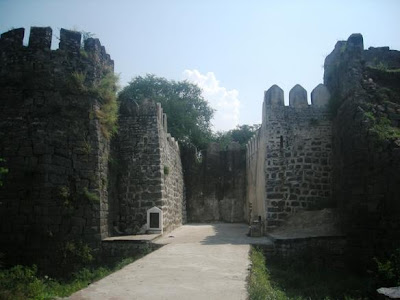
Karimnagar | Tourism | Ramagiri Fort

Ramagiri Fort / Khilla is situated in Kamanpur village at around 60Km from Karimnagar.
By Road

This fort is on the way while going from Karimnagar to Manthani. One need to follow the Karimnagar-Manthani road till Begumpet X roads and take right diversion there to reach the Begumpet village. The fort is around 2Kms from there and can be reached only on foot.

By Rail

The nearest railway station is 'Peddapalli' which is located on the NewDelhi<->Kazipet line. Ramagiri Khilla is around 20Km from there.

Profile

Ramagiri Fort, often referred as Ratnagarbha has as ancient fort believed to be used by Satavahanas and Kakatiyas as their Military establishment. This fort is remarked as the unconquerable fort is Telangana region. The hills and surroundings here are astounding to watch and contain many herbs of medicinal importance.

Ramagiri also has a temple of Sita and Rama with a Linga(incarnation of Lord Shiva) believed to be installed by Lord Rama. You can see the foot prints of Lord Rama & Sita here, supporting the claim that both stayed here for some time during there visit. Other attractions here are Sita’s vermilion box, Ganga Gouri wells, Gouri gundam, Brahma gundam, twin horses of Matsya kachpa, Mallvanam and Brindavanam.

Karimnagar | Tourism | Elgandal Fort


By Road

Elgangal or Veligandula is a small village in Karimnagar district, lying at around 10Km west of Karimnagar on the Karimnagar-Vemulawada road.

By Rail

The nearest railway station is 'Peddapalli' which is located on the NewDelhi<->Kazipet line. Elgandal is around 45Km from there.

Profile

Elgandal (some times spelt as Elagandal) is an ancient village with grand history. In olden days it was called as Bahudanyapuram. But it was known as Veligandula from Kakatiya times. This place has the historical significance of being ruled by 5 important dynasties - Kakatiyas, Musunuri Nayaks, Recherla Padmanayaks, Qutubsahis and Asaf Jahis(Nizams). Well-known poet Veligandula Narayana hails from this place. He has completed the lapses found in the Bhagavata of great poet Pothana. It is believed that he has composed the last two (11th and 12th) skandhas of Potana Bhagavathamu during 15th century A.D.

Elgandal Fort/Khilla

The fort of Elgandal played an important role from the period of the Kakatiyas to the Asaf Jahis in the history of the Deccan. It is situated on the banks of the Manair river amidst palm groves. The antiquities of the place worth mentioning are, Brindavan tank on the outside of the eastern gateway of the fort built by Zafar-ud-Doula in 1754 A.D. with minarets that oscillate when shaken, the mosque on the top of the hill and the temples of Neelakanthesvara and Narasimha Swamy lying on the hill fort.

The Narasimha Temple

After the mosque at lower level, there is Narasimha temple facing the east consisting of three separate rooms side by side with an open-yard enclosed by walls. The deity is noticed in the central room with Tripundras or three Namas on a black stone, which is worshipped as Narasimha swamy by the villagers.

Karimnagar | Tourism | Dhulikatta


By Road

Dhulikatta is a small village located at around 28Km from Karimnagar city and 5Km from Eligedu & Julapalli Mandal headquarters. One can follow the Karimnagar-Katnapalli-Eligedu-Dhulikatta route to reach this place. Katnapalli is located on Rajiv Rahadari(SH1) connecting Karimnagar-Peddapalli at a distance of around 20Km.

The actual Stupa is 4Km inside the village located on the banks of Hussainimiya Vagu amidst the agricultural lands. This place is not reachable on a car. You can go on a 2-wheeler to some distance and take a walk from there to reach this rather neglected historical monument.

By Rail

The nearest railway station is 'Peddapalli' which is located on the NewDelhi<->Kazipet line. Dhulikatta is around 23Km from there.

Profile

Dhulikatta is an important Buddhist site which contains many Buddhist stupas of the Satavahana period and one of the 30 walled cities mentioned by Megasthanes in his travel account, the Indica. Excavations have dated the site to have flourished between the 2nd Century BC to 2nd Century AD. The artifacts unearthed include remains of gateways built of light bricks, Mahastupas, residential houses, wells, punch-marked coins, Roman and Satavahana coins and seals. Experts estimate that forty-seven slabs were used to decorate the dome of the Stupa here. Remains of Chatra, Buddhapada, Charmachakra Stupa etc used to symbolically represent Buddha were found here. Other excavations have discovered Brahmi inscriptions on ayaka slabs and an ivory seal at the site. The bronze/copper idol of mother and child known as Ankadhatri is another important find.

Route Map

Karimnagar | People | Dr. C. Narayana Reddy


Cingireddy Narayana Reddy (సి.నారాయణరెడ్డి), a well-known Telugu poet and educational administrator, was born in Hanumajipeta village near Vemulawada of Karimnagar district. Dr Reddy was a professor at Osmania University. He became known to a wide public as a lyricist for several famous Telugu films.
Although a prolific writer, Dr. Reddy's poetry remains fresh. His diction is musical both in textual form and in recitation form. He doesn't use rhyme in a simple way but with associated internal rhyme in meaning and poetic metaphor. He is not particularly influenced by any of the poets who preceded him; his poetry is neither bound by the times in which it is written nor is it limited to any persuasion or style. Dr. Reddy's poetry is characterized by universal values of humanism, hope and well being of the people. He also has written thousands of songs for Telugu films. His poetic work Visvambara, which was translated into three other languages, earned him a Jnanpith award (1988).
Dr. Reddy has won several state level awards and the Soviet Land Nehru award (1982). The Government of India honoured him with the Padma Shri (1977) and the second highest civilian award, the Padma Vibhushan in 1992. Andhra University, Waltair honored him with Kala Prapurna in 1978. Dr. Reddy was also nominated to the Upper House of Indian Parliament in August 1997.

Karimnagar | People | Seshappa Kavi

Seshappa Kavi (శేషప్ప కవి) is believed to be of 1800 A.D. He hailed from Dharmapuri in Karimnagar District, the holy place on the banks of river Godavari famous for the ancient Narasimha Swamy Temple. He was a poet and dedicated his life to Narasimha Swamy.
He wrote three Shatakams.The first centennial is called 'Sri Nrukesaree' shatakam. The second is 'Sri Narasimha Shatakam'. The third one is known as 'Narahari Shatakam'. He claimed his linguistic skills are plain ordinary. Along with his skills with the language, he was a highly devout person and this shows in most of his poems.
Every poem of the Sri Narasimha Shatakam, clearly proves that Seshappa Kavi has mastered the Pothana's literary magnum opus "SrimadhaandhramahaaBhaagavatam" and had studied it in depth. For instance in the 74th poem, where he questions on the subject saying "why should caste or creed become a criteria to be blessed by Sri Hari?", quoting examples of Vyaasa, Viduraa, Vaalmiki, he also quotes :"Sri Suka", which is noteworthy. The first time "Suka" was called "Sri Suka" was by Bammera Potana and the only other who used the same is again our Seshappa.
It is important to note something here: the three words Hamsa--Parama Hamsa--Sri Parama Hamsa, have different annotations and meanings. The one who meditates on Brahman is Hamsa (check out the word "So Ham"), the deity who shines with the attributes of motionless and life (compare stillness,as in death and movement, as in life) is Parama Hamsa and that who is free of stillness (irrationality) and is full of life (Spirit and sensation) is Sri Parama Hamsa. Seers and philosophers have called "Sri Suka" as "Sri Parama Hamsa". Our beloved Seshappa clearly knows that "Suka" is not an ordinary "Suka", but "Sri Suka"

Karimnagar | People | P. V. Narasimha Rao


Pamulaparthi Venkata Narasimha Rao (పాములపర్తి వెంకట నరసింహారావు) (28 June 1921 – 23 December 2004) was the 12th Prime Minister of the Republic of India (1991-1996). He belonged to a Telugu Niyogi Brahmin family from a village called Vangara, BheemaDevaraPally Mandal in the Karimnagar district. He was the first and only Telugu to become the Prime Minister of India.
P. V. Narasimha Rao led one of the most important administrations in India's modern history, overseeing a major economic transformation and several incidents affecting national security. Rao accelerated the dismantling of the license raj, work that originally initiated under the government of Rajiv Gandhi. Rao, also called the "Father of Indian Economic Reforms," is best remembered for launching India's free market reforms that rescued the almost bankrupt nation from economic collapse. He was also commonly referred to as the Chanakya of modern India for his ability to steer tough economic and political legislation through the parliament at a time when he headed a minority government. As a member of the Congress-I party,he served as a chief minister (1971-73) in the Andhra Pradesh state government. He also held several central cabinet posts between 1980-89 under Indira Gandhi and Rajiv Gandhi, including foreign affairs minister and the defence minister.
Besides being a politician, PV was an eminent scholar. He was a polyglot and could speak 13 languages including Urdu, Marathi, Kannada, Hindi, Telugu and English with a fluency akin to a native speaker. In addition to seven Indian languages, he spoke English, French, Arabic, Spanish and Persian. Along with his cousin Pamulaparthi Sadasiva Rao, PV edited a Telugu weekly magazine called Kakatiya Patrika from 1948 to 1955.

Karimnagar | People | Siva Reddy

Shiva Reddy is a popular Telugu Mimicry artist and comedian. He has worked in over 100 film in Tollywood. He is popular for his imitation of popular Telugu film actors. He hails from Ramagundam, Karimnagar. As a child, Shiva Reddy was very interested in songs and dances, he used to dance for his school cultural programs. Shiva Reddy’s father used to take him to the temple where Shiva Reddy used to sing devotional songs.

During Shiva Reddy ‘s school days, he used to perform on the stage and imitate his teachers and principal. Also, Shiva Reddy used to imitate our temple priest to perfection. Everybody used to appreciate him and he used to enjoy the applause.This brought Shiva Reddy closer to every town. Since then he decide to pursue my talent.

After the completion of Shiva Reddy’s 10th class, he went to Madras to act in movies. Although everyone appreciated his talent they said he needed to wait since he was still young. Then Shiva Reddy came to Warangal to his sister’s place and a gentleman named Sri. Nellutla Praveen Chandra offered Shiva Reddy chance in Doordarshan. Late Sri. Sarangapani garu (renowned folk artist) encouraged him by taking Shiva Reddy with him in all his programs. There Shiva Reddy performed extensively in all his programs. In the process, Shiva Reddy earned goodwill and respect of people of Warangal district.

Later Shiva Reddy met filmmaker Sana Yadi Reddy and he asked Shiva Reddy to narrate few comedy anecdotes to him. He liked Shiva Reddy’s performance and asked him if he could use these skits in his movie.

He gave Shiva Reddy first opportunity in a movie titled ‘Pittala Dora’ as an artist. He granted Shiva Reddy opportunities in all his next ventures of which ‘Bachelors’ was a good success. After Bachelors, Shiva Reddy got an offer to act in a movie called ‘Ammai Kosam’ directed by Muppalaneni Siva on prestigious Eetaram banner. Shiva Reddy was one of 4 heroes in the movie. After this movie, Shiva Reddy got many roles like Anandam, Avunu Vallu Iddaru Istapaddaru, Manasantha Nuvve, Athade Oka Sainyam, Vasantham, Naaga, and Nenunnanu among many others.

Shiva Reddy received a standing ovation for his performance in 2004 when he came with Koti garu were he became very emotion seeing the audience response. The response is on par with the response Shiva Reddy got from India.